One of the most common misunderstandings in cybersecurity sounds harmless at first.
"We follow NIST, so we're compliant."
Or sometimes:
"We're ISO 27001 certified, so we're covered."
This belief causes real problems. Not because NIST CSF 2.0 or ISO 27001 compliance are weak. They are not. They are some of the most respected cybersecurity frameworks in the world.
The problem is simpler and more dangerous.
Frameworks are not laws.
They do not replace legal obligations. They do not automatically satisfy regulatory requirements. And they do not protect you from enforcement if you misunderstand their role.
This blog explains the difference clearly, without legal jargon, and shows how to use frameworks correctly. You will learn how NIST CSF 2.0 and ISO 27001 help you build a strong cybersecurity compliance program, why regulatory mapping is the missing step many organizations skip, and how frameworks support real laws like GDPR, DORA, U.S. sector regulations, and global breach notification regimes through strong governance risk management.
Why people confuse frameworks with laws
The confusion is understandable. Frameworks and regulations talk about many of the same things.
- Risk management
- Access controls
- Incident response
- Monitoring and detection
- Governance and accountability
So when teams implement controls aligned to a framework, it feels like compliance. Auditors like it. Customers ask about it. Sales teams promote it.
But there is a fundamental difference.
A law tells you what you must do and when.
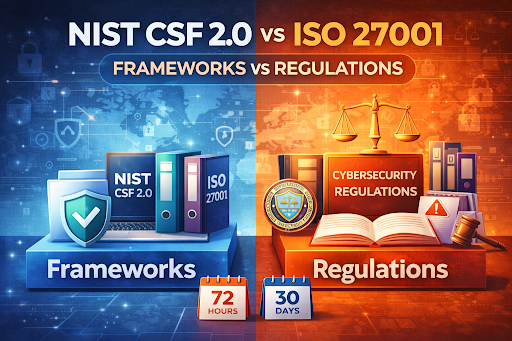
A framework tells you how to organize your security thinking and controls.
Frameworks are voluntary. Regulations are mandatory.
Frameworks are descriptive. Regulations are prescriptive.
Frameworks help you build capability. Regulations judge whether that capability meets a legal requirement.
Once you understand this distinction, everything else starts to make sense.

What NIST CSF 2.0 actually is
NIST CSF 2.0 is the latest evolution of the NIST Cybersecurity Framework. It is designed as a high-level, outcome-focused framework to help organizations manage cybersecurity risk.
It is not tied to a specific industry.
It is not tied to a specific country.
It is not a compliance checklist.
The framework is organized around core functions that describe what effective cybersecurity looks like across an organization.
With version 2.0, NIST placed even more emphasis on governance, integrating cybersecurity into enterprise risk management and business decision making.
This makes NIST CSF 2.0 extremely useful as a strategic foundation. It helps organizations:
- Create a shared cybersecurity language across teams
- Align security priorities with business objectives
- Identify gaps without jumping straight to tools
- Communicate risk to leadership and boards
- Structure improvement roadmaps over time
But none of this makes it a law.
What ISO 27001 really represents
ISO 27001 is an international standard for information security management systems. When people talk about ISO 27001 compliance, they often mean certification against that standard.
ISO 27001 is more structured and formal than NIST CSF. It requires:
- A defined information security management system
- Documented policies and procedures
- Formal risk assessment and risk treatment
- Management involvement and review
- Continuous improvement
Certification provides independent validation that your management system meets the standard.
That has real value. It signals maturity, discipline, and seriousness about security.
But again, ISO 27001 is not a law. It does not override regulatory requirements. Certification does not exempt you from breach notification rules, reporting timelines, or sector-specific mandates.
It proves how you manage security. It does not define what laws apply to you.
The core difference: intent versus obligation
Here is the simplest way to understand the gap.
Frameworks exist to help you manage risk.
Regulations exist to protect society, markets, consumers, and infrastructure.
Because of that difference, regulations contain things frameworks usually avoid.
- Hard deadlines
- Mandatory reporting timelines
- Specific legal definitions
- Penalties for non-compliance
- Regulator discretion and enforcement
No framework tells you to notify a regulator within 72 hours or 24 hours. No framework tells you which authority to notify or how to structure a legal disclosure. No framework defines what happens if you fail.
That is why saying "we follow a framework" is never a complete compliance answer.
Why regulators still like frameworks
Here is the important part. Regulators do not dislike frameworks. In fact, many regulators explicitly encourage or reference them.
The reason is simple. Frameworks are excellent tools for operationalizing requirements.
Regulators do not want every organization inventing security from scratch. They want consistency, repeatability, and measurable controls.
Frameworks provide structure. Regulations provide accountability.
When used correctly together, they reinforce each other.
The right way to think about a cybersecurity compliance program
A strong cybersecurity compliance program has three layers.
- Legal requirements
- Operational controls
- Evidence and governance
Frameworks sit in the operational controls layer. Regulations sit in the legal requirements layer. Governance connects everything.
If you skip the legal layer and start with a framework, you will eventually run into trouble. If you skip frameworks and try to implement regulations directly, you will likely build something brittle and inefficient.
The goal is alignment, not substitution.
Why regulatory mapping is the missing link
Regulatory mapping is the process of connecting legal requirements to framework controls.
It answers one critical question:
Which controls support which laws?
Most organizations do this informally, if at all. Someone says, "That's covered by NIST." Someone else nods. No one writes it down.
That is a mistake.
Without formal regulatory mapping, you cannot confidently say your framework-aligned controls actually meet legal obligations. You also cannot prove it during audits, investigations, or after incidents.
How regulatory mapping actually works in practice
Regulatory mapping does not need to be complicated.
You start with a regulation, not a framework.
For example, a regulation might require:
- Timely incident detection
- Defined incident response process
- Specific reporting timelines
- Senior accountability
- Vendor oversight
Then you look at your framework controls and ask:
- Which controls support detection
- Which controls support response
- Which controls support governance
- Which controls do not address reporting timelines at all
This is where the truth shows up.
Frameworks almost always support detection, response, protection, and recovery. They almost never address reporting deadlines or legal notification requirements.
So mapping exposes gaps that frameworks alone cannot fill.

Example: incident response under frameworks versus laws
Under NIST CSF 2.0, incident response is addressed as a capability. You should be able to respond, contain, recover, and learn.
Under ISO 27001, incident management is part of the management system. You need documented procedures and continual improvement.
Now compare that to real regulations.
Many laws require you to notify a regulator within a specific timeframe. Some require notification to affected individuals. Some require public disclosures. Some require specific content.
Frameworks help you run the incident. Laws tell you who to notify and when.
If you do not explicitly map reporting requirements outside the framework, your program will fail the moment timing matters.
Why governance matters more in NIST CSF 2.0
One of the most important changes in NIST CSF 2.0 is the stronger emphasis on governance.
Cybersecurity is no longer treated as a purely technical issue. It is explicitly tied to enterprise risk management, leadership oversight, and decision making.
This aligns closely with modern regulations, which increasingly focus on:
- Board oversight
- Executive accountability
- Risk ownership
- Decision documentation
This is where frameworks shine. They give you a language and structure to embed cybersecurity into governance.
But again, governance must be tied to actual regulatory expectations, not just internal maturity goals.
Global reality: one framework, many laws
Most organizations today operate across borders.
That means you may face:
- European data protection laws
- Financial services regulations
- Critical infrastructure mandates
- Sector-specific cybersecurity rules
- National breach notification laws
No single framework replaces this complexity.
But a framework can help you manage it, if you use it correctly.
The trick is to treat the framework as your control backbone and map each jurisdiction's requirements onto it.
Why certification alone is not legal protection
ISO 27001 certification is often misunderstood as a shield.
It is not.
Certification demonstrates that you follow a recognized management system standard. It does not guarantee compliance with every applicable law. It does not prevent fines. It does not override legal obligations.
In enforcement actions, regulators rarely ask, "Are you certified?"
They ask:
- What controls did you have
- How were they operating
- What decisions were made
- What obligations applied
- Did you meet them
Certification may help demonstrate good faith and maturity. It does not replace compliance analysis.
A practical way to use NIST CSF 2.0 correctly
Here is how mature organizations use NIST CSF 2.0 without falling into the "framework equals compliance" trap.
They use it to:
- Define desired security outcomes
- Structure internal control categories
- Communicate risk in business language
- Assess maturity and gaps
- Prioritize improvements
They do not use it to:
- Claim compliance with specific laws
- Avoid understanding reporting obligations
- Replace legal analysis
When someone asks, "Are we compliant?" the answer is never "We follow NIST." The answer is, "Here is how our controls align to the applicable regulations."
A practical way to use ISO 27001 compliance correctly
ISO 27001 works best as a discipline enforcer.
It forces you to:
- Document risk decisions
- Maintain governance structures
- Run internal audits
- Review performance regularly
- Improve continuously
That makes it an excellent platform for compliance. But only if you explicitly integrate regulatory requirements into the ISMS.
That means:
- Including regulatory obligations in risk assessments
- Mapping legal requirements to Annex A controls
- Including compliance metrics in management reviews
- Testing regulatory workflows, not just technical controls
Without this integration, certification and compliance drift apart.

How frameworks support real laws when used properly
Frameworks become powerful when they are used as translators.
They translate:
- Legal obligations into operational controls
- Abstract requirements into measurable activities
- Executive expectations into security priorities
This is where governance risk management becomes real. Governance is not meetings. It is decision ownership. Risk management is not lists. It is tradeoffs. Frameworks help structure both.
A simple model that actually works
Here is a model that works across industries and regions.
- Start with laws and regulations
- Identify obligations and deadlines
- Map obligations to framework control categories
- Implement controls and workflows
- Collect evidence
- Review and improve
Frameworks sit in the middle, not at the top.
Common mistakes that cause compliance failures
- Assuming framework adoption equals legal compliance
- Ignoring reporting timelines because they are not in the framework
- Failing to document regulatory mapping
- Separating governance from operational security
- Treating certification as an endpoint instead of a tool
These mistakes show up repeatedly in investigations and audits.
What regulators actually want to see
Regulators generally want to see:
- You understood your obligations
- You implemented reasonable controls
- You had governance and oversight
- You acted in good faith
- You met required timelines
- You documented decisions
Frameworks help with most of this. They do not cover all of it.
Bringing it all together
Frameworks are essential. Laws are unavoidable.
NIST CSF 2.0 and ISO 27001 give you structure, language, and discipline. They help you build a strong cybersecurity compliance program. They support governance risk management. They make complex environments manageable.
But they do not replace legal obligations.
The organizations that get this right do one thing consistently. They use frameworks as tools, not shields. They map controls to laws. They test regulatory workflows. They treat governance as a living process.
That is how frameworks actually help you comply with real regulations worldwide.
References
- NIST, Cybersecurity Framework 2.0 Overview
https://www.nist.gov/cyberframework - NIST, Cybersecurity Framework 2.0 Concept Paper and Updates
https://www.nist.gov/cyberframework/csf-20 - ISO/IEC 27001:2022 Standard Overview
https://www.iso.org/standard/27001 - ISO, Information Security Management Systems and Certification
https://www.iso.org/isoiec-27001-information-security.html