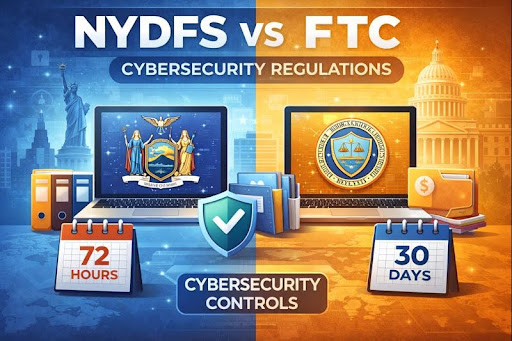
If you operate in U.S. financial services, you've probably had this exact moment.
Someone says, "We need to comply with NYDFS and GLBA."
Then the room goes quiet, because everyone knows what comes next. Two regulators. Two rulebooks. Different definitions. Different reporting clocks. And one security program that has to hold it all together without turning into a never-ending compliance treadmill.
Here's the good news. You do not need two separate cybersecurity programs. You need one solid program built around the strictest expectations, with clear add-ons for the parts that differ. Done right, you reduce duplicate work, simplify audits, and build a security posture that actually lowers risk instead of just producing paperwork.
This blog compares:
- The NYDFS cybersecurity regulation (23 NYCRR Part 500), enforced by the New York Department of Financial Services
- The FTC Safeguards Rule under GLBA, commonly called the GLBA Safeguards Rule, enforced by the Federal Trade Commission for covered "financial institutions" under the FTC's jurisdiction
We'll focus on what matters in real life:
- Who is covered
- What controls are expected
- How reporting works, including the NYDFS 72-hour rule and extortion payment notices
- How to build one set of financial institution cybersecurity controls that meets both requirements
Why these rules feel different even when they overlap
At a high level, both NYDFS and the FTC want the same outcome: protect customer information and reduce cybersecurity risk. But they come from different regulatory styles, and that shows up in how organizations experience compliance.
NYDFS is a state financial regulator. Its cybersecurity rule is written with a "this must operate in production" tone. It emphasizes governance, documentation, and fast reporting. It also has specific incident notification expectations and a distinct workflow for extortion payments.
The FTC Safeguards Rule is a federal consumer protection rule under GLBA. It is designed to cover a wide range of non-bank businesses that handle consumer financial information. It is risk-based, but the modern version is far more specific than it used to be, with clearer minimum requirements and a formal breach notification requirement to the FTC for certain events.
That's why compliance teams often say NYDFS feels stricter. Not because the FTC is weak, but because NYDFS tends to push faster incident timelines, heavier executive accountability, and more "prove it" documentation discipline.
Who is covered under each rule
Who must follow NYDFS cybersecurity regulation
NYDFS Part 500 applies to covered entities regulated by the New York Department of Financial Services. In plain terms, if your organization is licensed, registered, or otherwise authorized by NYDFS under relevant New York financial services laws, you likely fall under the rule.
This commonly includes many banks, insurers, and other DFS-regulated financial services organizations. It can also include certain affiliates depending on structure and licensing.
NYDFS also distinguishes "Class A companies" based on size thresholds and applies additional enhanced requirements to them. If your organization qualifies as Class A, you should expect extra program maturity expectations in certain areas.
Who must follow the FTC GLBA Safeguards Rule
The FTC Safeguards Rule applies to "financial institutions" under the FTC's jurisdiction that are not overseen by another federal regulator for GLBA safeguards enforcement. This is the part many businesses miss.
"Financial institution" here can be broader than what people imagine when they hear the word. It can apply to many non-bank entities engaged in financial activities, including certain lenders, finance companies, mortgage brokers, debt collectors, credit counselors, and other businesses that handle consumer financial information.
So it's possible for a corporate group to have both rules in play across different business lines. One unit may be NYDFS-regulated, while another unit falls under the FTC rule. That is exactly when building one harmonized control program becomes the smart move.

What each rule expects at the program level
NYDFS expects a cybersecurity program that can actually run
NYDFS requires covered entities to maintain a cybersecurity program designed to protect the confidentiality, integrity, and availability of information systems and nonpublic information. It expects the program to be based on risk assessment and to support core operational functions like identifying risk, protecting systems, detecting events, responding, recovering, and meeting reporting obligations.
In other words, the rule expects you to be able to operate under stress, not just write policies.
The FTC expects a written information security program with specific elements
The FTC Safeguards Rule requires covered entities to develop, implement, and maintain a comprehensive information security program. It must be appropriate to the company's size and complexity, the nature of its activities, and the sensitivity of the customer information handled.
But modern compliance is not just "we have a plan." The updated Safeguards Rule includes more specific requirements, like designating a qualified individual to oversee the program, maintaining written risk assessments, implementing access controls and monitoring, encryption expectations, incident response planning, and service provider oversight.
Both rules are risk-based, but both now have enough specificity that you can build a fairly concrete baseline program without guessing.
The overlap is big, and that's where you should focus
If you want to avoid duplicate work, you build one baseline program that satisfies the shared requirements. The overlap shows up in a few consistent control families.
Risk assessment and risk management
Both rules push you to evaluate risk formally and manage it over time. That means you need more than a one-time assessment. You need a living process that tracks changes in systems, vendors, threats, and business operations.
A strong approach is to maintain a single enterprise security risk assessment methodology that can be applied to:
- Nonpublic information and regulated business systems under NYDFS
- Customer information and consumer data flows under the FTC Safeguards Rule
Then you feed that into a risk treatment plan with owners, deadlines, and evidence.
If you do this well, it becomes the foundation for everything else, including why you implemented certain controls and why certain exceptions exist.
Governance and accountability
Both regimes care about who owns cybersecurity, who is accountable, and how leadership is informed.
NYDFS places heavy emphasis on senior accountability and requires annual compliance certification or acknowledgment with executive involvement. The FTC requires a "qualified individual" to oversee the program and expects reporting to leadership.
If you want one program to satisfy both, build a governance structure that includes:
- A clearly designated security program owner with authority
- Regular leadership reporting cadence
- Defined escalation thresholds for major risks and incidents
- Documented decision making for exceptions and risk acceptance
When governance is clear, audits are cleaner and incident handling becomes faster.
Access controls and strong authentication
Both rules push you toward limiting access, controlling privileged accounts, and implementing multi-factor authentication or equivalent protections.
This is where financial institution cybersecurity controls often succeed or fail. Credential abuse is one of the most common real-world attack paths, and financial services organizations are prime targets.
A baseline program that supports both regimes typically includes:
- Least privilege and role-based access for sensitive systems
- Strong authentication for remote access and privileged actions
- Privileged access management controls, even if lightweight
- Regular access reviews for critical platforms
- Offboarding controls that remove access quickly
This is one of the best areas to invest in because it reduces risk and satisfies compliance expectations at the same time.

Encryption and data protection
Encryption is a major theme across both rules, and for good reason. Customer information exposure is expensive, and encryption can meaningfully reduce harm when devices are lost, backups are stolen, or cloud storage is exposed.
A practical baseline for both NYDFS and FTC compliance is:
- Encryption in transit everywhere, including internal service connections when feasible
- Encryption at rest for endpoints, servers, databases, cloud storage, and backups that contain customer information
- Clear exception handling with documented compensating controls
- Key management practices that prevent encryption from being a checkbox
Encryption done properly reduces incident severity and also simplifies breach analysis under the FTC rule, because the FTC breach notification requirement focuses heavily on whether consumer information was unencrypted.
Incident response planning and testing
Both regimes expect incident response capability. Not a binder. Capability.
A single incident response program should include:
- Clear roles, including an incident commander and compliance reporting owner
- Playbooks for ransomware, data exposure, third-party incidents, and credential compromise
- Evidence preservation steps that support investigations and reporting
- Tabletop exercises and lessons learned
- Backup and recovery testing, because ransomware resilience is not theoretical anymore
The important piece is that incident response must be connected to regulatory reporting workflows, which is where the biggest differences live.
Service provider oversight
Third-party risk is a major factor under both NYDFS and the FTC rule. If vendors handle customer information or provide critical services, they are part of your risk perimeter whether you like it or not.
A shared baseline approach includes:
- Vendor security due diligence before onboarding
- Contract requirements for security controls and incident notification
- Ongoing vendor monitoring for high-risk providers
- A vendor incident escalation workflow tied directly into incident response
If you build this properly, you reduce the chaos that happens when a vendor incident is discovered through a news article instead of a direct notification.
The differences that actually change your workflows
This is the part you cannot ignore. These are the places where one program needs "forks" or add-ons.
Difference 1: Reporting timelines and what triggers reporting
NYDFS has a fast notification timeline. Covered entities are expected to notify NYDFS within 72 hours after determining that a cybersecurity incident has occurred, under the rule's incident definition and criteria.
NYDFS also has a separate reporting requirement for extortion payments. If an extortion payment is made, the rule requires notice to NYDFS within 24 hours, and then a written follow-up explanation within 30 days that covers why payment was necessary and what diligence was performed.
This is operationally important. It means ransomware payment decisions must be treated as a compliance trigger, not just a business decision.
The FTC breach reporting requirement works differently. It requires notifying the FTC within 30 days after discovery of a "notification event," generally involving unauthorized acquisition of at least 500 consumers' unencrypted information, based on the rule's definitions.
So here's the practical reality:
- NYDFS is driven by incident determination and operational impact. It pushes fast escalation.
- FTC reporting is driven by consumer data acquisition thresholds and encryption status. It pushes detailed breach assessment and consumer impact evaluation.
If your incident response program can meet the NYDFS reporting discipline, meeting FTC timing is usually easier. But if you build only for FTC timing, you can still fail NYDFS speed expectations.
Difference 2: How "incident" is defined and what ransomware means
NYDFS treats ransomware seriously in its incident definition logic. Certain ransomware deployment situations can trigger the incident definition and reporting expectations faster than many teams expect.
The FTC rule is not focused on ransomware as a concept. It is focused on whether customer information was acquired in a way that meets the notification event definition and the threshold. A ransomware event can still become FTC-reportable, but the reasoning path is different. You typically have to assess data access, encryption status, and affected consumer count.
This difference matters because ransomware response often starts with operational pain and downtime. NYDFS is more directly aligned to that operational impact mindset. FTC reporting is more aligned to consumer information exposure analysis.
Difference 3: Documentation and annual certification posture
NYDFS is heavy on documentation and executive accountability. It expects formal annual certification or acknowledgment and supporting evidence retained over time. That creates a very specific "prove your program is real" obligation.
The FTC also expects documentation and program proof, but it tends to be centered around having a written information security program, risk assessments, evidence of implemented safeguards, and service provider oversight.
What this means in real life is simple: if NYDFS applies to you, you should treat evidence collection as part of routine operations, not an annual scramble. Build a living evidence library.
How to build one program that satisfies both without duplicating work
Here is the most practical way to do it, especially for organizations with limited bandwidth.
Step 1: Map scope once, then stop arguing about it
Create a scope map that identifies:
- Systems and processes that fall under NYDFS because they support a DFS-regulated unit
- Systems and processes that fall under the FTC Safeguards Rule because they handle customer information for an FTC-covered business line
- Shared systems used by both
Most organizations discover that identity, endpoint management, email, cloud platforms, network controls, and vendor ecosystems are shared. That is where you standardize controls.
Step 2: Adopt the strictest timeline as the internal incident standard
Internally, you should run your escalation discipline as if NYDFS timelines apply, even if only one unit is NYDFS-regulated. It prevents confusion and reduces the risk of late reporting.
This means:
- You can determine incident reportability quickly
- You can produce regulator-ready incident summaries
- You can handle ransomware payment decisions with a 24-hour reporting trigger
- You can receive vendor incident notifications fast enough to meet a 72-hour clock
You do not want to be negotiating vendor notification timing during an incident. You want it already baked into contracts and escalation paths.
Step 3: Standardize baseline financial institution cybersecurity controls
Build one baseline control set that includes:
- Risk assessment and risk treatment tracking
- Identity and access management with MFA
- Encryption and key management
- Logging and monitoring
- Vulnerability management and patch discipline
- Incident response playbooks and testing
- Backup and recovery testing
- Vendor due diligence and incident notification requirements
- Security training
- Governance reporting and documented decision making
This baseline supports both NYDFS and the FTC. Then you add specific rule-driven workflows on top.
Step 4: Add FTC-specific breach assessment logic as a repeatable routine
Because FTC reporting is based on a defined "notification event," you need a repeatable method to answer:
- Was customer information involved
- Was the information unencrypted as defined by the rule
- How many consumers were affected
- Does the event meet the FTC reporting threshold
- If yes, can we assemble the required report content accurately
This is not something you want to invent mid-incident. Build a checklist and test it.
Step 5: Add NYDFS-specific reporting and extortion payment workflows
NYDFS adds two practical workflow requirements that must be built into incident response:
- A 72-hour notification workflow triggered by incident determination
- A 24-hour extortion payment notice workflow triggered by payment execution, plus a 30-day written explanation process
The key is connecting the payment decision to compliance. If payment is coordinated by counsel, insurers, or negotiators, your security reporting owner must still be alerted immediately when payment happens.

The scenario that tests everything: ransomware plus a payment decision
This is where teams either look prepared or fall apart.
Ransomware creates:
- Operational disruption
- Leadership pressure
- Time-critical recovery decisions
- External partner involvement
- Potential data exposure risk
- Potential payment decisions
If NYDFS applies, you must be able to move quickly on notification. If a payment is made, the payment triggers its own clock.
If FTC applies, you must assess whether consumer information was acquired and whether it meets the notification threshold and encryption conditions.
The reason this scenario is so hard is that it mixes operational recovery and legal analysis at the same time. That is why one integrated incident response and compliance workflow is essential.
What "audit-ready" looks like for both rules
You do not need perfect security. You need reasonable and documented security that operates consistently.
Audit-ready organizations typically can show:
- A current written security program and governance structure
- A documented risk assessment and risk treatment plan
- Evidence of access controls and authentication enforcement
- Encryption coverage and exception handling
- Logging and monitoring practices
- Incident response plans and proof they are tested
- Vendor oversight and contract controls
- Executive and board reporting evidence where expected
- A clear reporting workflow for NYDFS and FTC triggers
When evidence is collected continuously, compliance becomes much simpler. When evidence is collected once a year in a panic, compliance becomes fragile.
Conclusion: one program, two regulators, less chaos
The simplest way to approach this is:
Build one strong baseline that satisfies 23 NYCRR 500 compliance discipline, because it tends to demand faster action and stronger governance.
Layer FTC breach assessment and FTC reporting thresholds on top.
If you do that, you end up with:
- Stronger financial institution cybersecurity controls
- Fewer duplicated policies and audits
- Faster incident escalation and cleaner reporting
- Better vendor readiness
- A program that is easier to defend when something goes wrong
That is the goal. Not just compliance, but resilience that holds up in the real world.
References
- New York Department of Financial Services, Cybersecurity Resource Center (Part 500 guidance and timelines)
https://www.dfs.ny.gov/industry_guidance/cybersecurity - NYDFS, 23 NYCRR Part 500 Second Amendment text (including Section 500.17 incident notification and extortion payment notice)
https://www.dfs.ny.gov/industry_guidance/regulations/final_adoptions_fs/rf_fs_2amend23NYCRR500_text_20231101_alt - Federal Trade Commission, "FTC Safeguards Rule: What Your Business Needs to Know" (overview and compliance expectations)
https://www.ftc.gov/business-guidance/resources/ftc-safeguards-rule-what-your-business-needs-know - FTC Press Release (deadline extension and list of updated Safeguards Rule elements like qualified individual, risk assessment, encryption, incident response plan, MFA or equivalent)
https://www.ftc.gov/news-events/news/press-releases/2022/11/ftc-extends-deadline-six-months-compliance-some-changes-financial-data-security-rule - Federal Register, "Standards for Safeguarding Customer Information" (Safeguards Rule breach reporting amendment and effective date)
https://www.federalregister.gov/documents/2023/11/13/2023-24412/standards-for-safeguarding-customer-information - FTC Business Blog, "Safeguards Rule notification requirement now in effect" (FTC reporting requirement overview)
https://www.ftc.gov/business-guidance/blog/2024/05/safeguards-rule-notification-requirement-now-effect - eCFR, 16 CFR Part 314 Standards for Safeguarding Customer Information (regulatory text)
https://www.ecfr.gov/current/title-16/chapter-I/subchapter-C/part-314